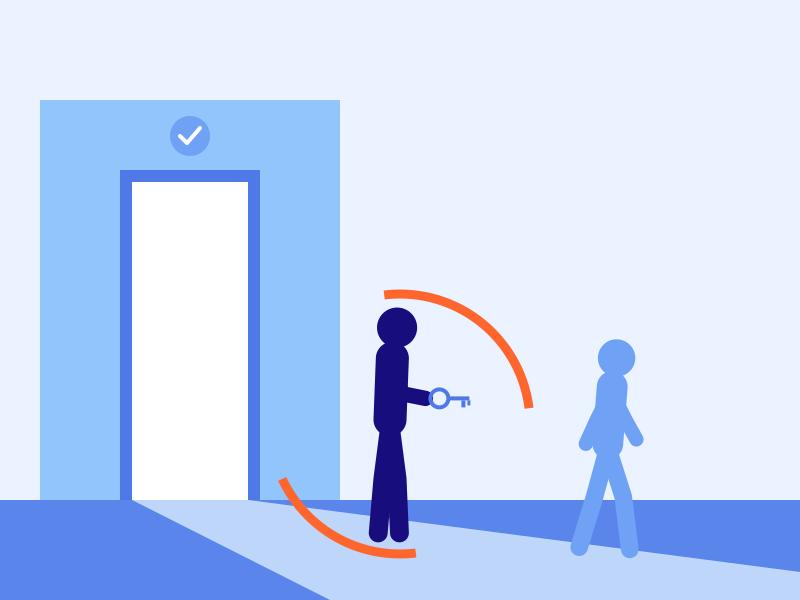
The login checked out and the session was stolen anyway, because the attacker never needed to log in. A session token is a bearer credential: whoever presents it is treated as the user.
Key takeaways
- Login checks protect the moment of sign-in. A stolen session token lets an attacker skip that moment entirely.
- Infostealer crews are now going after AI assistant sessions too, because one live session carries a person’s identity, context, and authority together.
- Shorter token lifetimes and token binding help. Only a check on the person, repeated through the session, answers who is actually at the keyboard.
What actually gets stolen
After a successful login, applications hand the browser a token, such as a session cookie or an OAuth token. From then on, systems check the token, not the person. Attackers get these tokens mainly two ways: infostealer malware on the user’s device, or an adversary-in-the-middle proxy that sits between the user and the real login and copies the token in transit. In both cases the login succeeded honestly. The theft happened after it.
That is why a stolen token is so useful to an attacker. It skips the password and every other login check, and the system accepts it as a valid session.
A real example, and what it shows
In the fall of 2023, attackers broke into Okta’s customer support system and reached files belonging to 134 customers. Some of those files were browser recordings (HAR files) that contained session tokens. The attackers used them to hijack the real Okta sessions of five customers. The lesson was not that the login was weak. The lesson was that a token, once taken, works on its own.
Now the same pattern is aimed at AI assistants
Recent analyst reporting describes criminals stealing session tokens from AI assistant users. The reason is simple: a live agent session holds a person’s identity, their context, and their authority in a single object. A stolen one gives an attacker all three without facing a login check or a device check. The reporting is new and details will keep evolving, but the direction is clear.
One vendor figure gives a sense of scale. Obsidian Security reports that session hijacking attacks rose 127 percent year over year in 2026. That is a vendor measurement, so read it as directional, not exact.
Why the front door cannot see it
Every control at the front door did its job. The credential was valid. The token was signed. The session came from a plausible place. Nothing looks wrong, because the architecture verified the credential, not the person holding it. A credential is not a person.
What closes the gap
Three things help, and they work together:
- Make the token harder to reuse. Shorter lifetimes, token binding where available, and conditional access shrink the window. They are worth doing.
- Know every connection that carries a token. Inventory your OAuth connections and limit their scopes, so one stolen session cannot cascade across your tools.
- Check the person, all session long. Mimoto Continuous Verification confirms the specific person is the one present, from how they type and move, how they use their apps, their device and connection, and the context of the session. It uses advanced pattern matching and anomaly detection, and it never captures what someone types. When a session stops matching the verified person, Mimoto recognizes it and responds in real time, from re-verifying to ending the session. It sends its signals to your SIEM and other SOC tools and notifies your team in Slack, Microsoft Teams, Google Chat, PagerDuty, email, or any channel your team prefers.
An honest caveat: nothing here makes theft impossible. The goal is to catch the session while it is happening, not after the data is gone. Mimoto responds in real time, only as far as the risk warrants.
A note for Cybersecurity Awareness Month
The National Cybersecurity Alliance’s theme for Cybersecurity Awareness Month 2026 is “Don’t Make It Easy for Them.” Strong logins are part of that. Then ask the next question: what checks the person after the door closes?
Questions answered
Does a strong login stop session hijacking?
No. Login checks protect the moment of sign-in. Session hijacking steals the token created after login, so the attacker presents a session that is already open.
Why does a stolen session token work?
A session token is a bearer credential. Systems accept whoever presents it, without asking the person to prove who they are again.
How do attackers steal session tokens?
Mainly through infostealer malware on the user’s device and adversary-in-the-middle proxies that copy the token during login.
How can you detect a hijacked session?
By checking whether the person driving the session still matches the verified person, continuously, instead of trusting the token alone. That is what continuous verification does.
Sources
- Sysdig, Session Hijacking: How It Works and How to Stop It, August 7, 2026.
- Obsidian Security, Session Hijacking: How It Works and How to Stop It, February 25, 2026, updated September 24, 2026 (the 127 percent figure, reported by the vendor).
- BleepingComputer, Okta breach: 134 customers exposed in October support system hack, on the 2023 incident.
- KuppingerCole, A Peek into AIID2026: AI Agents Are the New Insider Threat, October 5, 2026.
- Cyber Magazine, Cybersecurity Awareness Month: Don’t Make It Easy For Them, October 2026.