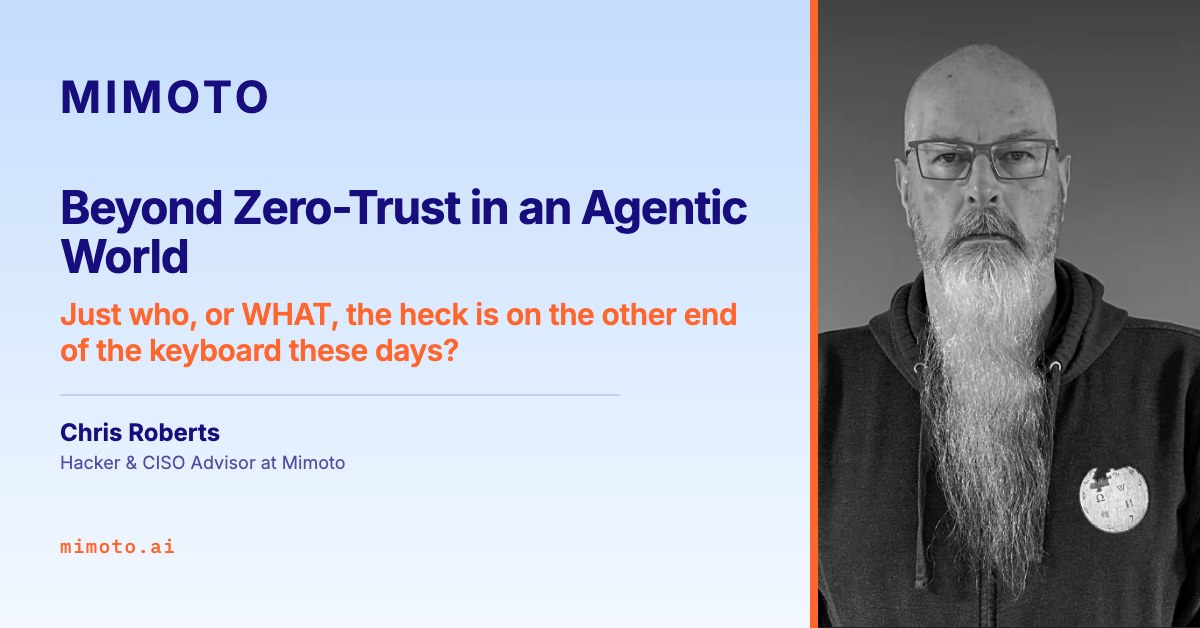
Most security checks prove who or what is acting at one moment, then trust it for the rest of the session. In Mimoto’s speaker session at Big SASIG 2026 in London, Chris Roberts, Global Field CTO at World Wide Technology (WWT) and CISO Advisor to Mimoto, explains why that breaks in the agentic era, why Zero Trust needs one owner, and six moves to start this week. Watch the talk, or read the main points below.
Key takeaways
- A check proves who or what is acting at one moment. In Chris’s words: “We built verification as a snapshot, yet the actor is a movie.”
- Zero Trust has no natural owner. Identity, network, and endpoint teams each hold a third of it, and nobody owns the outcome.
- Six moves to start this week: give Zero Trust an owner, inventory every actor, classify authority, verify continuously, assure in the moment, and rehearse “what happens if.”
Who, or what, is on the other end of the keyboard?
Chris measures the problem with a number he calls Opposite Keyboard Knowledge: how much an organization actually knows about who, or what, is on the other side of the keyboard. He walks it up in stages.
Where we were: zero. The basic questions had no reliable answers. What do we have? Where is it? What is it doing? Who is on it, and who should be? What happens if something goes wrong, and would we even know?
Where most of us are: about 25 percent. IT, networking, HR, and security each have their own count of physical assets, and digital assets are harder still. We know what the SIEM and the SOC tell us a device is doing, sometimes. The last tabletop exercise was a few years ago. “But we’re compliant!”
Where we should be: about 50 percent. An asset inventory that keeps itself current, continual threat assessment, identity management tied to physical and other controls, scenario-based testing run again and again, and policies and controls that allow for growth and for recognized exceptions.
Why doing all the right things still leaves a gap
Even at 50 percent, Chris says, something is missing. We checked that the right person was at the keyboard, that the right system was doing the work, and that the agent was doing the right thing in the right place. Every one of those was true, at one moment in time.
The rest of the gap is everything after that moment. Is it still the same person, system, or agent ten minutes later? Are the same hands on the keyboard? Is the agent still doing what we asked, or drifting, or being steered? Chris borrows a line from philosophy and Buddhism for it: what once was, is no longer.
We built verification as a snapshot, yet the actor is a movie.
Chris Roberts, Big SASIG 2026
His short version is a list of questions most organizations cannot answer with proof today:
- Is this the same person you checked 10 minutes ago, or someone wearing their session?
- Is this the person you hired, on this morning’s call, or a deepfake of them?
- Are these the same hands on the keyboard, or a bot that just cleared your CAPTCHA?
- Is this the same call-center agent, or a voice clone?
- Is this token still doing only what you granted it?
- Is this the authorization you allowed, or is someone taking liberties?
Closing that gap takes Opposite Keyboard Knowledge to 99 percent. Not 100, because nothing ever is.
Who owns Zero Trust?
Chris’s answer: often nobody. Ask the three teams usually handed Zero Trust what it means. Identity says authentication. Network says micro-segmentation. Endpoint says posture and device health. Each answer is a third right.
So organizations buy three overlapping platforms and declare victory. Procurement owns the renewal, and nobody owns the outcome. The plan changes whenever a new executive arrives with a checkbook. Chris calls that vacuum, not any single control gap, the real risk, and points out who inherits it when it fails: the person who could not set the strategy alone. That is why he likes tabletop exercises. They find this out before it happens in production.
Six moves to start this week
Chris’s advice is to save the money and own your way out:
- Give Zero Trust an owner. One name, not three teams each holding a third.
- Inventory every actor, not just every asset. People, service accounts, bots, and agents.
- Classify authority, not just access. What an actor can decide, not only what it can reach.
- Verify continuously. Is it human, and is it the right one, for the whole session, not just at login?
- Assure in the moment. Finding out next Tuesday is an autopsy, not security.
- Rehearse “what happens if.” This quarter, not “a few years ago.”
Why this matters more now
The assumption most controls were built on, that a human is on the other end, has broken. Chris gives five reasons:
- AI has moved from advising attackers to doing the attacking. An attack can go from reconnaissance to data theft in hours.
- Frontier AI models now find zero-day flaws that humans missed for decades. That cuts both ways.
- Every agent is a new identity, and the credentials agents collect sit on nobody’s org chart.
- A decade of controls has become attack surface. Login checks can be relayed, and machines now clear CAPTCHAs easily.
- Agents are deployed faster than they are governed, and the window to change that is closing.
The gap, in numbers
Chris compared published surveys on how many organizations are putting agents into production, and how many of those are building security in. The surveys, from Gartner, Deloitte, McKinsey, PwC, and others, count differently, so he averaged them.
| Measure | Chris’s average | What the surveys showed |
|---|---|---|
| Deploying agents into production | 48.5 percent | 17 to 79 percent, depending on whose survey and how it counts |
| Of those, building security or governance in | 32 percent | 21 to 45 percent. 45 was the best case he found. |
He also cited two figures that explain the worry: 86 percent of companies are delaying deployments because of security concerns, and 88 percent have already had a security incident. His summary: adoption is outrunning governance, and that gap is the exposure. Read the exact numbers as direction, not precision. The pattern is the point.
From attestation to assurance
The biggest shift Chris describes is in the security leader’s job: from proving we were compliant to proving we are secure, right now.
| From | To |
|---|---|
| Attestation, quarterly | Assurance, continuously |
| “We passed the audit.” | “We can show who is acting, and why, this very second.” |
A point-in-time check is a snapshot, and the threat lives on well past that moment. Compliant is not secure. For a room that starts with governance, risk, and compliance, Chris says, that is the whole conversation. The CISO stops being the gatekeeper and becomes air-traffic control, built on communication, collaboration, cooperation, and coordination, not conflict.
Questions to ask every vendor
Chris’s advice for the market: take these to every vendor, and do not accept a slogan (or socks).
- Can you tell a human from an agent? Where: in the moment, at inflection points, or just at login?
- Can you identify which specific human? Continuously, for the whole session? How?
- How do you govern non-human identities? As first-class actors? Explain your reasoning.
- Is it real time? Or do I read about it afterward?
- Is enforcement native? Or do I need to rip and replace my IAM, SIEM, and fraud stack?
- Who, in your model, owns the outcome? And what do they do with it?
What to take with you
- Compliant is not secure. The certificate on the wall never stopped an attacker, and AI does not care about it either.
- Assume identity is already breached, human and non-human, and design for it. You will not stop everyone from getting in, so plan accordingly.
- This is a people and trust problem wearing a technology costume.
- The actor on the other end changed. Our proof of who they are has not. Fix that.
- Ask better questions of your vendors, your teams, and yourself, before you press the big red button.
Chris closes with two questions for one identity layer. Is it human? And is it still the right human, checked continuously? Never 100 percent, he says, but a long way past today. This week: name an owner, and inventory every actor.
Where Mimoto fits
Those two closing questions are the ones Mimoto is built to answer. Mimoto Continuous Verification checks, all session long, that it is the right human, the specific person the session belongs to, which also means a real human is there. It measures how a person types and moves, how they use their apps, their device and connection, and the context of the session, and never what someone types. When a session stops matching, Mimoto responds in real time, enforcing natively or sending signals to the SIEM and other SOC tools you already run, with no rip and replace. At a website’s sign-up forms, a separate product, Mimoto Continuous CAPTCHA, makes a clear call on every sign-up: person or agent.
An honest caveat: a product does not give Zero Trust an owner, inventory your actors, or rehearse your response. Those moves belong to people. Mimoto covers the continuous check, the part Chris says most of us cannot prove today.
Questions answered
What does Chris Roberts mean by Opposite Keyboard Knowledge?
It is his measure of how much an organization actually knows about who, or what, is on the other end of the keyboard. He puts most organizations at about 25 percent, a mature program at about 50, and continuous checks on the actor at 99, because nothing is ever 100.
Why is Zero Trust not enough in the agentic era?
Most checks prove who or what is acting at one moment, then trust it. People, systems, and agents change after that moment: a session can be taken over, and an agent can drift or be steered. The check has to continue for the whole session.
Who should own Zero Trust?
One named person. Chris points out that identity, network, and endpoint teams each own about a third of it, so nobody owns the outcome.
What is the difference between attestation and assurance?
Attestation proves you were compliant at audit time, often quarterly. Assurance, in Chris’s terms, shows who is acting, and why, right now, continuously.
What should you ask a security vendor about AI agents?
Whether it can tell a human from an agent, and which specific human, continuously; how it governs non-human identities; whether it works in real time with native enforcement; and who owns the outcome.
Sources
- Chris Roberts, Beyond Zero-Trust in an Agentic World, talk and slides, Big SASIG 2026, Bishopsgate Forum, London, September 9, 2026.
- The agent adoption and governance figures are Chris Roberts’s averages of published surveys from Gartner, Deloitte, McKinsey, PwC, and others, as shown in the talk. The 86 and 88 percent figures are as cited in the talk.